Babb, S., McNaughton, D., Light, J., Caron, J., Wydner, K., & Jung, S. (2020). Using AAC video visual scene displays to increase participation and communication within a volunteer activity for adolescents with complex communication needs. Augmentative and Alternative Communication, 36(1), 31-42. doi:10.1080/07434618.2020.1737966
LINK TO ARTICLE
The Challenge
Volunteer activities can provide opportunities to learn new skills, build social networks, and contribute to enhanced self-esteem. Volunteering also provides a positive contribution to society, and an opportunity to participate in activities that may differ from those in paid employment. People with severe disabilities and complex communication needs, however, may face significant barriers in participating and communicating in volunteer activities.
Augmentative and alternative communication (AAC) can assist individuals with disabilities with complex communication needs to complete tasks and engaged in communication exchanges through these two outcomes:
- It can serve as an instructional support in learning new skills
- It can be used as an AAC technique to provide relevant, timely communication to support the interaction with others
The Current Study
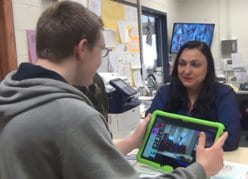
In this study, Babb and colleagues used video VSDs with adolescents with autism spectrum disorder or Down syndrome while they participated in a volunteer activity. Then, they measured completion of the volunteer tasks and communication exchanges with their other volunteers.
Graduate students created the video VSDs for the targeted activities through recording separate videos of each of the steps of the activities, editing the clips in iMovie, and then uploaded to the video VSD app on the tablet. When a step of the activity involved a communication act, the researchers created a hotspot on the VSD and recorded the relevant communication message.
During the baseline sessions, the participants were cued to complete the volunteering task while the researcher observed and completed a task analysis. The participants did not have access to the video VSD app, which was typical for their school program, and were not given any instruction on the steps of the tasks.
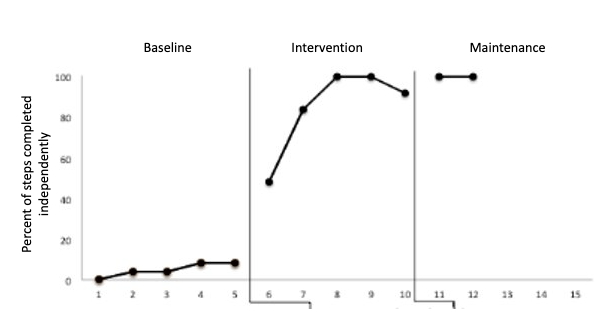
Here is an example of the percent of steps completed independently by Ivan in packing backpacks as a volunteer service.
Conclusions
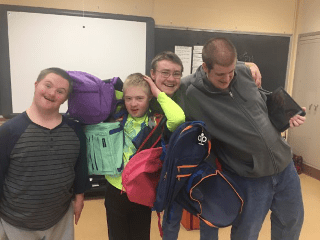
This study provided meaningful community participation while using AAC video visual scene displays to increase participation and communication within a volunteer activity. This project also provides evidence of the benefits of providing AAC supports for meaningful participation in socially valued activities – in this case, a needed community service. The volunteer activity provided over 160 students with needed food backpacks each week and was clearly valued by community members.
This study provides evidence that the use of video VSD technology by adolescents with severe disabilities and complex communication needs can result in both increased independence for task completion and successful interaction with a variety of communication partners.
Babb et al., (2020)